Everything One Wall Can Hold: The Movement Vocabulary Behind PiWall
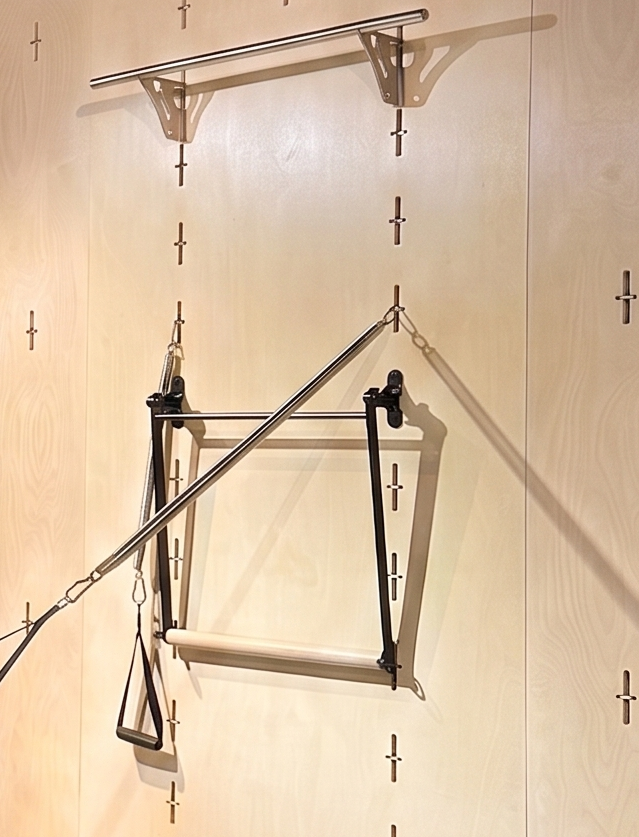
PiWall didn't invent a new way to move. It brought two already-mature systems onto the same wall — one built on wall-supported yoga, the other on the spring-and-bar architecture of the Pilates tower — and gave them a shared attachment system to work from. What that actually opens up is easier to show in movement terms than in spec-sheet terms. Here's a walk through the categories of work PiWall makes possible, and where each one comes from.
Two Systems, One Wall
Long before PiWall, the wall was already doing serious work in two separate rooms.
In Iyengar yoga studios, it's the rope wall — ropes suspended from wall-mounted hooks at two or more heights, a system B.K.S. Iyengar developed decades ago that practitioners still call Yoga Kurunta, from the Sanskrit for "puppet." The ropes hold a practitioner in a pose long enough, and with enough support, to actually find alignment rather than muscle through the shape.
In Pilates studios, the same instinct produced the tower: the trapeze table's spring, bar, and strap system, scaled down and mounted flat against a wall wherever a full Cadillac didn't fit.
Neither tradition treated the wall as a stationary prop. Both engineered real resistance and support into it, decades before "wall Pilates" became a hashtag. PiWall's attachment points, spring tension, and strap and handle configurations are built to carry that same logic forward — not to imitate either system, but to hold both vocabularies on one surface.
Standing Work and Alignment
Rope wall yoga's most everyday use is also its most useful: standing poses held with a rope for counter-tension. Trikonasana, Virabhadrasana, Parivrtta Parsvakonasana, Prasarita Padottanasana — poses most practitioners already know — done with something to pull against instead of relying on muscle alone to hold the line. It's less about making the pose easier and more about making the alignment legible: a teacher can feel, and the practitioner can feel, exactly where the body is cutting a corner.
On PiWall, a handle set at the right height does the job a rope has done for sixty years. For a studio, it's a fast way to teach alignment cues that are hard to say out loud and easy to feel with resistance in hand.
Extension and Backbend Work
We've written before about the suspension work built around Salabhasana and Pilates' Swan series — an advanced hold that puts the posterior chain and core directly against gravity. It's worth tracing where that idea comes from on both sides. Rope wall practitioners use the same counter-tension to build toward deeper backbends like Kapotasana, opening the chest and shoulders in stages rather than forcing the full shape cold. Pilates arrives at similar territory from the equipment side, with spring-resisted extension work that strengthens the same posterior chain a backbend eventually asks for.
Different starting points, same conclusion: back extension gets safer, not harder, once something is actively supporting or resisting the movement instead of leaving it to gravity alone.
Suspension, Traction, and Decompression
This is where both traditions get more careful, and any programming built around it should too. Rope wall yoga uses suspension for gentle spinal traction — supported hangs and inversion-adjacent work that Iyengar teachers often use therapeutically, including with practitioners managing back issues. The Pilates tower reaches similar territory through Push-Through Bar and Feet in Straps work, where spring tension takes load off the spine while the practitioner controls the movement rather than dropping into it.
How far this translates onto a specific PiWall installation depends on attachment height, strap length, and how the unit is mounted. For anything approaching full suspension or inversion work, that's worth working through with us directly, rather than assuming one configuration fits every wall.
Hip and Leg Work
Pilates' Leg Springs series — supine work through hip flexion, abduction, adduction, and circles — exists because isolating the hip from the rest of the body is easier with a fixed anchor point than with a floor mat alone. Rope wall yoga solves a related problem from standing or reclined positions: Supta Baddha Konasana and Supta Padangushtasana, traditionally practiced with a rope looped around the foot so the leg can hold a position the arms would otherwise have to fight for.
PiWall's strap attachments give both approaches the same fixed point the floor never could — vertical instead of horizontal, doing the same isolating work.
Standing Arm and Shoulder Work
Arm Springs work — seated or standing shoulder flexion, extension, and rotation against spring resistance — was some of the first Cadillac repertoire to move onto wall-mounted tower units, for a simple reason: none of it needs a table underneath it. It's also some of the most directly transferable work onto PiWall, since handle attachments at shoulder height cover most of the series without modification. For studios building rotator cuff and upper-back strength into warm-ups, it's a fast, low-footprint station.
Building a Session, Not a Routine
None of this is a fixed sequence — it's a vocabulary, the same way a full Cadillac or a rope wall is a vocabulary rather than a script. A studio session might move through standing alignment work, into extension, and finish with hip or leg work; a home practitioner might use two of these categories one morning and the other two later in the week. The sequencing is still the instructor's work, or the practitioner's, standing in front of the wall. PiWall's job is making sure the wall doesn't run out of vocabulary before they do. You can see some of this in motion on @pilateraspilates.
If you want to talk through what a specific PiWall configuration could support — a studio programming several class formats, or a home practice with one wall to work with — get in touch. We're happy to think it through with you.